A Quiet Hour for Naming What You Want to Carry Forward
Use a quiet hour to choose one quality, practice, or relationship to carry forward, with a reflection that makes room for uncertainty instead of resolutions.

A quiet hour can help you choose what you want to carry forward without turning the next year into a list of assignments. The useful question is not “What should I improve?” but “What deserves a place in the life I’m already living?” Your answer might be a quality, a small practice, or a relationship you want to tend.
This reflection works best as a decision guide, not a test. Different circumstances call for different kinds of attention. You might be ready to name something clearly, still sorting through a difficult year, or unsure whether an old commitment belongs in the future at all. The right choice is the one that feels honest and possible to revisit, not the one that sounds impressive.
Set a quiet container
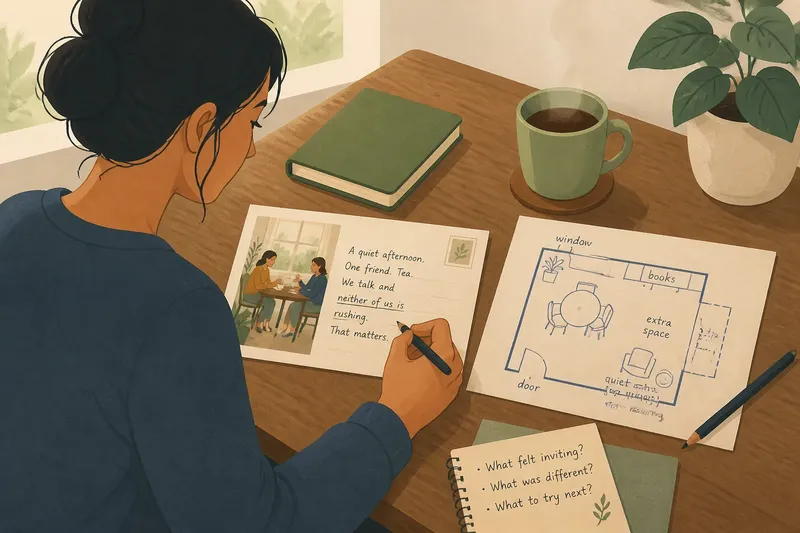
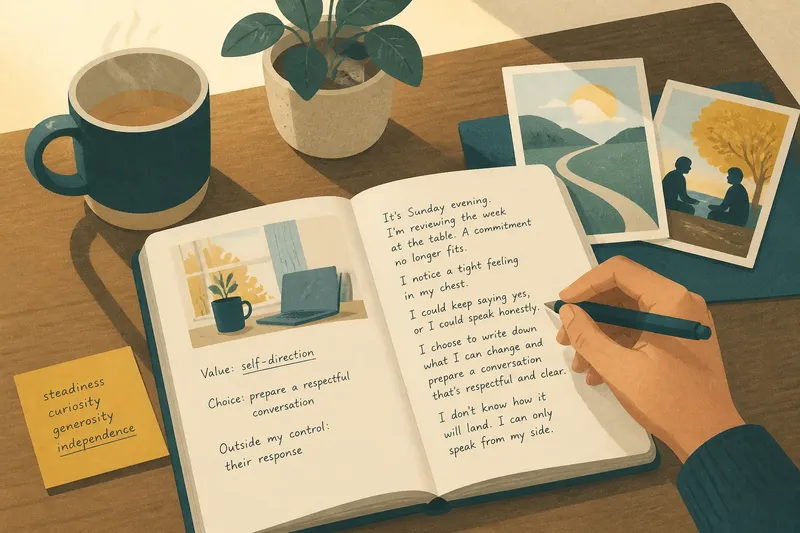
Choose a time and place where you can be unhurried. A notebook and pen are enough; a cup of tea or a familiar chair may help mark the hour as different from ordinary planning. Put your phone out of reach if notifications tend to interrupt your thoughts. You do not need to fill the whole hour with writing.
Divide the time into three loose parts: noticing, choosing, and making room for uncertainty. These are invitations, not timed stages. If one question opens up more than you expected, stay with it. The point is to listen for a thread, not to complete a worksheet.
Begin by writing a few plain observations about the year. What gave you steadiness? When did you feel most like yourself? What did you keep returning to, even when circumstances changed? Avoid grading your answers. “I called my sister while I walked home” is more useful than “I was a good sibling,” because the first gives you something specific to understand.
If the year felt full
If you have many possible answers, do not try to carry them all forward. Look for the quality beneath several moments. Perhaps patience helped you listen during a tense conversation, learn an unfamiliar task, and recover after a setback. The repeated quality may be a better choice than any single activity.
Write down a few moments that mattered, then underline words that recur. You might notice care, curiosity, courage, humor, or a wish for more quiet. Ask which word describes something you want to keep practicing, rather than something you feel obliged to display.
Imagine you are deciding between “read more” and “curiosity.” Reading is a specific activity, but curiosity may also show up in questions you ask at work, a recipe you try, or a walk through a neighborhood you do not know well. If curiosity is the thread across those moments, it may fit better as the quality to carry forward. The action can change while the underlying intention remains recognizable.
If the year felt difficult
If the year brought loss, exhaustion, or disruption, you do not have to turn hardship into a lesson. Start with what helped you get through ordinary days: a friend who listened, a boundary that protected rest, a brief moment outdoors, or the willingness to ask for help. You can choose to carry forward support or self-compassion instead of setting a new demand.
A relationship may be the right focus when a person’s presence mattered more than any routine. Naming it does not mean promising to be available at all times. You might want to carry forward the relationship by making room for honest conversation, by receiving care, or by recognizing that connection can take different forms.
If nothing comes to mind, that is information too. You might write, “I need more time before I know.” Keep that sentence rather than forcing a polished answer. A reflection can be complete for now even when it produces a question instead of a decision.
If an old commitment weighs
Sometimes the thing you once wanted no longer fits. A practice may have become another source of pressure, or a relationship may have changed in ways you need to acknowledge. Carrying something forward does not mean preserving it in its old form. You can keep the value underneath it while releasing the particular arrangement.
Ask what the commitment was meant to serve. If a weekly group was your way of finding community, perhaps community still matters, even if that group no longer suits you. If a demanding routine was meant to support health, you can keep the wish to care for yourself without repeating the same routine. The distinction lets you honor what mattered without treating past choices as binding instructions.
Questions for your choice?
How do I choose between a quality and a practice?
Choose a quality if the same intention appears in several parts of your life or if the right action may change. Choose a practice if one small, repeatable action already feels meaningful and supportive.
What if I cannot name one thing?
Write down the uncertainty and choose a question to revisit, such as “What gives me steadiness?” You can leave the hour without a final answer; reflection is not a demand for certainty.
Does carrying a relationship forward require a promise?
No. You can name what you value about the relationship without setting a schedule or making a commitment you are not ready to keep. Consider whether the relationship feels mutual and what kind of contact is realistic.
How can I keep this from becoming a resolution?
To keep this from becoming a resolution, describe what you want to make room for rather than setting a performance standard. A quality or relationship can guide choices without becoming a rule you use to judge every day.
Keep the intention open
Once you have a candidate, write one sentence that names it and why it matters. For example: “I want to carry forward my patience because it helps me stay present when someone needs time.” If your answer is a relationship, name the quality of connection you value; if it is a practice, say what it gives you. Keep the sentence close enough to reread, but do not turn it into a pledge.
Then add one gentle way to notice it in ordinary life. You might recognize patience when you let a conversation unfold without rushing, or notice connection when you accept an invitation rather than deciding in advance that you are too busy. This is not a target to hit. It is a way to see whether your choice still feels alive once the calendar changes.
Leave space beside the sentence for a later note. Your circumstances may shift, and the shape of a quality, practice, or relationship can shift with them. A quiet hour for naming what you want to carry forward does not need to settle the whole year; it can give you one honest thread to follow, revise, or set down when you understand more.