Postcard or Sketch: Two Ways to Picture What Comes Next
Postcard or sketch exercises help turn a vague hope into a detail you can examine, so you can choose a small, reversible action without treating it as a prediction.
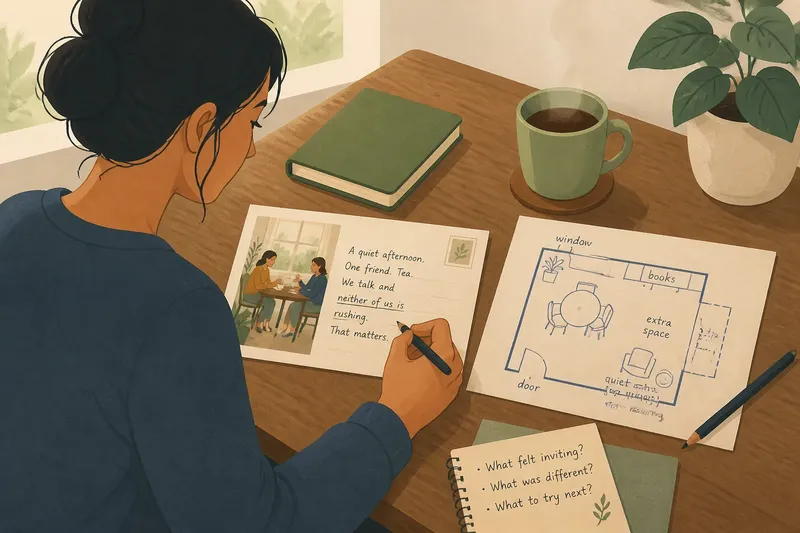
A postcard or sketch can help turn a vague hope into a detail you can examine. A postcard gives you a brief account of an ordinary moment; a sketch helps you map what is present and what is missing. Neither predicts what will happen. Each offers a different way to ask what a hope means to you.
Different ways of noticing
A postcard uses sequence and language. Writing about one moment can reveal what you value in it: companionship, quiet, room to learn, or time without interruption. The words may also expose assumptions. “A creative life,” for instance, could mean making things regularly, sharing them, or simply having time to experiment.
A sketch uses placement and space. A table, a doorway, an empty chair, or a path can show how people and activities relate without requiring a complete explanation. A blank area might mean flexibility, or it might mark a question you have not answered.
Choose the form for the question you have. If you need to understand what happens and why, words may help. If you need to notice relationships, access, or room for an activity, a rough diagram may be clearer. You can change forms when the first one stops helping.
Choose a useful frame
Keep the imagined scene modest: one ordinary day, one place, and one activity. A postcard can be a few lines written from that moment, addressed to someone who would understand why it matters. A sketch can be a floor plan, a set of symbols, or a few labeled objects. Use scrap paper, a pencil, or a basic drawing app; polish is beside the point.
Say you hope to make more room for friendship, but the phrase feels too broad. Write a few lines about an imagined afternoon at home: one friend is visiting, tea is on the table, and neither of you is rushing to the next errand. Underline “neither of you is rushing.” That detail suggests the hope may be about unhurried attention, not hosting an elaborate event. A small present-day experiment might be inviting that friend for a simple visit; afterward, note whether the pace felt more important than the setting.
If you choose a sketch instead, draw only the objects needed to understand the moment. Label anything ambiguous. A chair near a window could mean a welcoming place, a quiet place, or simply a chair; a brief note can clarify which meaning you intend.
What can each form answer?
A postcard is useful for questions about experience: What is happening? Who is there? What feels different? It can also help distinguish a value from a particular plan. Wanting to feel curious does not by itself mean you need a new job or a formal course.
A sketch is useful for questions about arrangement: Where does the activity happen? What is nearby? What has to move or make room? It can show practical constraints that a written description overlooks, while leaving the larger meaning open.
Neither form needs to settle the future. Treat the page as a draft you can revise or discard. Its purpose is to make one part of a hope easier to inspect.
Questions about the exercise?
What if I cannot draw?
Use boxes, arrows, stick figures, or labels instead of realistic images. A simple floor plan can show where an activity might fit without requiring drawing skill.
What if writing makes the future feel fixed?
Use tentative phrases such as “I might like” or “I would be curious to try,” and describe one moment rather than a permanent identity. You can write about what you are exploring instead of claiming an outcome.
Should I use both forms?
Use both only if each adds a different kind of information. A few written lines might clarify why a scene matters, while a small sketch can show where its activity takes place.
What should I keep?
Keep the version that makes a value or possible next action easier to name. If neither helps, set the pages aside and choose a smaller moment or a different question.
From image to action
Do not turn every imagined detail into an obligation. Find one feature within your influence, then consider a small, reversible way to explore it. If the page suggests a quiet place for reading, moving a chair near a lamp for one evening could help you notice whether the setting matters. If it suggests relaxed conversation, a short visit may clarify whether time, location, or company is most important.
Afterward, write down what felt inviting, inconvenient, or different from what you expected. That observation is not a verdict on the larger hope; it is information you can use to revise the scene. A postcard or sketch works best when it helps you name a value and choose what to notice next.