Before the Vision Board, Write the Future as a Story
Future as a story turns a broad hope into a clear daily choice, helping you recognize the values you want to carry into ordinary moments.
Writing the future as a story makes a broad hope easier to examine: you can see what you might choose in an ordinary moment. Before making a vision board, draft one scene that gives a value a specific action. The scene is not a prediction. It is a way to consider what a preferred way of living could ask of you.
Start with a value
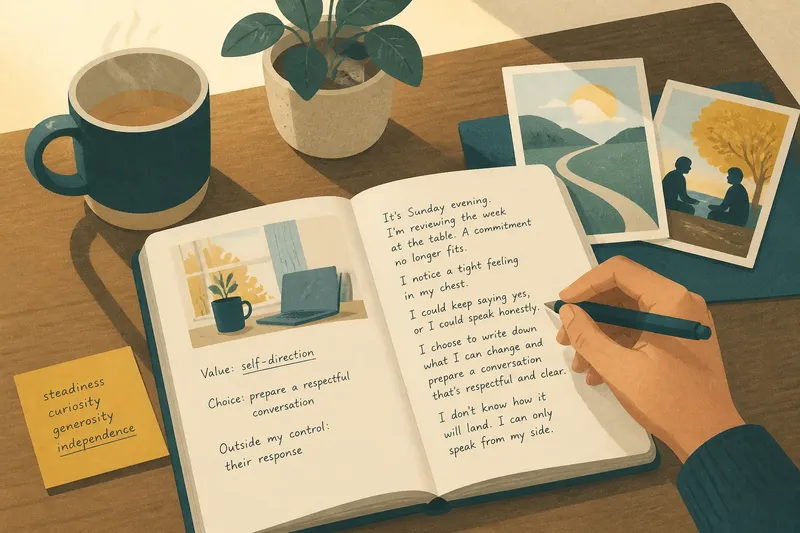
Choose a quality you want to make more room for, such as steadiness, curiosity, generosity, or independence. Then ask what someone could actually see you doing when that quality matters. “More connection” might become listening without checking your phone. “More creativity” might mean opening a notebook and giving an unfinished idea your attention.
A value becomes easier to consider when it points to a choice. The action does not need to be impressive or permanent. It only needs to make the quality recognizable in one particular moment.
Give the scene a choice
Set the scene in a familiar place and include a small point of friction: a changed plan, an invitation, a difficult email, or a crowded calendar. Show what you notice, what options you have, and what you choose. Keep the details that help explain the decision; leave out decoration that does not.
Say you want more independence, but the word still feels vague. Imagine you are reviewing your week at the dining table and notice a commitment that no longer fits. You write down what you can change, then prepare a respectful conversation about it. The resulting scene gives independence a visible shape: reviewing an obligation and speaking honestly, without promising how the other person will respond.
Write a possible day
A scene can be a short paragraph. Give it a setting, a moment that calls for a choice, and an ending that shows what you did. Use first person if it feels natural, and allow uncertainty with phrases such as “I might,” “I notice,” or “I choose.” That wording keeps the story open to revision.
For a scene about care, imagine a tired version of you receiving a friend's request to talk. You notice the urge to agree automatically, pause, and offer a time when you can listen with more attention. The scene makes room for both care and an honest limit; it does not claim that every conversation will go smoothly.
Small physical details can anchor the moment, but they should serve its meaning. A cooling mug beside a laptop may show that work has run late. If the detail does not help you understand the choice, the scene probably does not need it.
Keep the draft flexible
A vivid scene can feel persuasive without being a workable plan. Treat it as a prompt, not a contract. If a scene feels forced, ask what quality it is trying to express. A busy home, for instance, may represent belonging, while the value you actually want is dependable conversation. A quieter scene might express that value more clearly.
You can write two versions of one moment: the response that comes easily now, and a plausible response that better reflects the value you chose. Compare the actions rather than judging either version. The useful difference might be asking for time, naming a need, or making a choice instead of agreeing automatically.
Let the imagined day include limits, interruptions, and mixed feelings. The future version of you is not a perfect character. A value can guide a choice without appearing in every exchange or resolving every problem.
Questions about future stories?
How long should a future scene be?
Start with a few sentences about one moment and one choice. Add detail only when it helps you understand the value or action at stake.
Should I use present or future tense?
Present tense can make the scene feel immediate, while future tense can create distance. Choose the form that helps you write clearly, and change it if the scene starts to sound like a prediction.
What if I cannot picture the future?
Choose a quality you want more room for and place it in a familiar setting. One imagined exchange or decision is enough; you do not need to picture an entire life.
When should I use a vision board?
A vision board can help you keep a chosen value in view, but it is not required. If you use one, select an image that reminds you of the action in your scene, rather than one that simply looks appealing.
Turn a scene into a prompt
After writing, identify the value, the choice, and the part that remains outside your control. For example, in the independence scene, the value is self-direction, the choice is to prepare a conversation, and the other person's response is uncertain. This distinction helps keep the prompt focused on what you can consider or do.
If an image helps you remember the scene, add one to a board and write a few words beside it. A journal sentence or a note on your desk can serve the same purpose. Return to the prompt when a related choice comes up, and revise it if the value or circumstances have changed. The phrase “future as a story” is most useful when it points back to a real choice you can examine, not a scene you must reproduce.