A Future Scene Begins with an Ordinary Tuesday
Build a future scene from an ordinary Tuesday to examine how a hoped-for change might fit into the places, routines, and responsibilities of daily life.
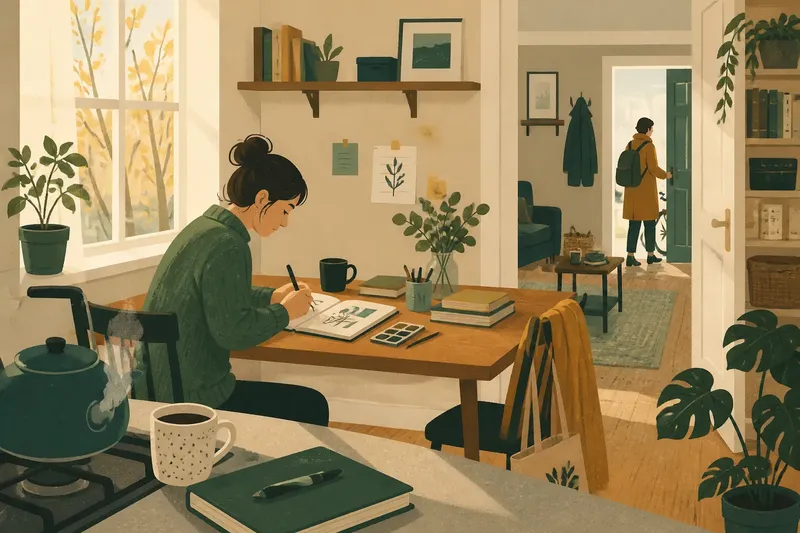
A future scene becomes easier to examine when it begins with an ordinary Tuesday, not a distant achievement. Instead of picturing only a new job, a move, or a creative milestone, place that possibility inside a familiar day: how morning begins, where you spend time, and what you do repeatedly. Those details help you notice what you want the future to feel like and what might need to change for it to fit.
This is a short writing exercise, not a prediction or a commitment. You will choose one possibility, set it in a specific day, and inspect the scene for useful clues. Keep the details modest. A believable cup of coffee or a familiar bus stop can reveal more than an elaborate picture of success.
Choose one possibility
Start with a hope that matters to you but remains open to question. It might involve changing the shape of your work, spending more time near family, learning a skill, or making room for a regular creative practice. Choose one possibility only; combining several makes it difficult to tell which one the scene is helping you examine.
Write the possibility in a plain sentence. For example: “I may want a workweek with more time for independent projects.” Use language that leaves room for uncertainty. “I may want” or “I’m curious about” keeps the exercise exploratory, while “I must do this” can turn it into a verdict before you have considered the everyday reality.
Now give the scene a simple boundary. Imagine one ordinary Tuesday a while after this possibility has begun to take shape. You do not need to specify a calendar date or decide that every part of the change has already happened. The point is to look at a day in which the possibility has enough presence to affect your routine.
Set the morning
Begin at the first moment you can picture clearly. Where do you wake up? What do you notice before reaching for your phone? What is the first task or decision of the day? Write a few concrete details, choosing things you can sense or observe rather than broad judgments such as “I feel successful.”
A morning might include light at the kitchen window, a kettle starting, a child’s lunch to pack, or the sound of a neighbor leaving for work. Include responsibilities that are likely to remain part of your life. A scene that removes every ordinary obligation may feel pleasant, but it gives you little information about how the possibility could coexist with the life you already have.
Let the morning show the difference the hoped-for change makes, if any. Perhaps you have a quieter start, or perhaps the same early routine now serves a different purpose. Don’t force a dramatic improvement. A subtle shift, such as being able to write before opening email, can be enough to make the possibility more specific.
Choose a familiar place
Move from the morning into a place you recognize or can imagine clearly. It could be a home desk, a library, a community center, a workplace, or the route you take to an appointment. A familiar setting gives the scene edges. It helps you ask whether the hoped-for change belongs in your real surroundings or depends on an entirely different life.
Notice what is physically there. Is the chair near a window? Do you share the table? Is there a coat rack by the door, a notebook beside the computer, or a reliable place to pause on the way home? You are not designing an ideal room. You are locating the possibility in the kinds of places where your days actually unfold.
Consider who else appears. A partner, coworker, friend, or neighbor may be part of the scene, even if they are not central to it. The question is not whether everyone approves of the imagined future. It is whether the scene reminds you of relationships, needs, or boundaries that deserve attention as you consider it.
Include one repeated activity
Give the imagined Tuesday one activity that happens regularly. Repetition is useful because it shows the texture of a life beyond its milestone moments. You might prepare the next day’s work, walk a familiar route, attend a class, make dinner, or spend time on a project. Choose something connected to the possibility, but do not make every action in the scene symbolize it.
Ask what the activity requires. Does it need quiet, supplies, energy, another person’s help, or a particular time of day? What does it displace? A recurring creative hour, for instance, might require moving a household task or setting a boundary around messages. These are not objections; they are practical features of the imagined day.
Say you are curious about making time for illustration alongside your current work. Imagine a Tuesday when you finish a meeting, eat at the kitchen table, and draw for a while before preparing dinner. You might notice that the idea feels appealing when the drawing has a regular place, but less appealing if it depends on staying up late. That observation can help you revise the possibility without deciding yet whether to pursue it.
What belongs in a future scene?
How specific should the details be?
Use details you can picture without inventing a complete biography for your future self. A place, a routine, and a few sensory cues are usually enough to make the scene inspectable. If you catch yourself adding elaborate decorations or achievements, return to what you do during an ordinary hour.
What if the future is uncertain?
Keep uncertainty visible in the wording. Describe one possible version of the day rather than claiming it is what will happen. You can also write down two small variations, such as working from home or going to a shared workspace, and notice what changes in each scene.
What if the scene feels disappointing?
Disappointment can be information about the possibility, the details you chose, or the expectation that the scene should feel inspiring. Ask which part seems wrong and revise that part only. A flat scene may point to a missing need, such as companionship, rest, or a clearer purpose.
How long should the scene be?
Write enough to follow the day through its main transitions, but stop before you start filling space. A few short paragraphs can hold a morning, a setting, a repeated activity, and an evening response. The value comes from what you notice, not from producing a polished story.
Read for useful clues
After writing, read the scene once without editing it. Underline details that feel appealing, then circle details that seem strained, vague, or borrowed from someone else’s idea of a good life. A detail can be both appealing and difficult; keep both reactions in view rather than forcing a single verdict.
Then answer three questions in writing. For an invented illustration, imagine Maya writes that she most wants to keep the quiet hour drawing at the kitchen table; she would need to move dinner preparation earlier; and the scene assumes her partner can take over a household task without discussing it. Those answers point to a valued quality—protected creative time—and two conditions to examine: the timing of dinner and a conversation about shared work.
- Which ordinary moment in the scene do I most want to keep?
- What part of the day would require a real adjustment?
- What assumption about myself or other people is the scene relying on?
Use the answers as clues, not as a demand to act. If the details depend on conditions you do not have, identify them as conditions. If the scene feels right only when a recurring responsibility disappears, consider whether support or a different arrangement belongs in the picture rather than dismissing the hope.
Revise one detail
Make one small revision based on what you noticed. You might move the repeated activity to a different part of the day, replace an unfamiliar setting with a more plausible one, or add a conversation that the first version left out. Changing one detail at a time makes it easier to see what affected your response.
Read the revised scene and notice whether it feels more grounded, less appealing, or simply different. All three responses can help. You are not trying to persuade yourself that the possibility will work. You are making it clear enough to consider with care.
Keep the scene open
Save the scene with a brief note about what it helped you notice. That note might name a valued quality, such as steadiness or creative freedom, or an unresolved question about time, place, or connection. The scene can remain unfinished; leaving room for change is part of using imagination thoughtfully.
Return to the ordinary Tuesday when the possibility feels abstract again. A future scene does not have to settle what you should do. It can show which parts of a hoped-for life deserve a closer look, and which everyday details you would want to protect as you consider what comes next.